
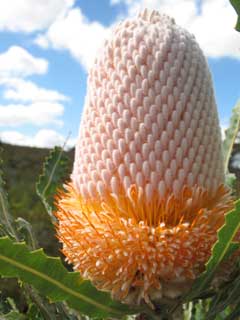
Banksia prionotes
FLORA -
Trigg Bushland is unique and diverse. It consists of 17 different plant communities, and it contains five priority plant species. It also has three Threatened Ecological Communities - northern Spearwood shrublands/woodlands, Acacia shrublands on tall dunes, and Callitris preissii forest.
The reserve's unique progression of vegetation types becomes apparent if you start near the coast at the south-west corner of the reserve and walk inland. Away from the spinifex and other colonisers of the fore dunes are low heaths featuring fan flowers (Scaevola crassifolia) and, with their pale grey-blue leaves, coast daisy-bush (Olearia axillaris).
Further in are groves of Rottnest cypress (Callitris preissii). It is thought that thick forests of cypress were formerly quite common along the coastal strip of the Swan Coastal Plain. The susceptibility of cypress to fire and the practice of burning the bush may have reduced its distribution, but the effects of European settlement have had most impact. This is one of the last places in Perth where natural groves of Rottnest cypress are still found. (More information on Callitris preissii.)
West of Elliott Road dense thickets of summer-scented wattle (Acacia rostellifera), interspersed with emergent tuart trees (Eucalyptus gomphocephala) dominate the slopes.
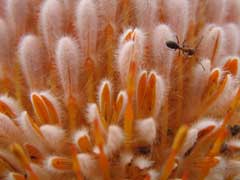
Banksia prionotes - detail
The eastern section of the reserve is mostly an open woodland of tuart and acorn banksia (Banksia prionotes) with an understorey that includes one-sided bottlebrush (Calothamnus quadrifidus) and dune moses (Acacia lasiocarpa).
Other significant species, and uncommon in the metropolitan area, are dune sheoak (Allocasuarina lehmanniana) and corkybark (Gyrostemon ramulosus). Corkybark is usually a tree of the dry inland.
The northern section of the reserve is a woodland of tuart, marri, jarrah and banksia with a diverse understorey of balga (grasstree), zamia, and species of peas, wattles and orchids.
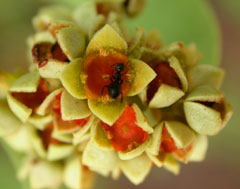
Quondong blossom
Santalum acuminatum
Like the banksias, parrotbush (Dryandra sessilis) is very attractive to honeyeaters. Both parrotbush and quandong (Santalum acuminatum), with its conspicuous red fruits, occur where limestone is near the surface.
Tuart has suffered throughout the reserve from too frequent fires, ecological imbalances (not enough cockatoos or parasitic wasps to control the tuart longicorn beetle) and canker fungi. However, in parts of the reserve, tuart shows good signs of recovery.
Download flora list for Trigg Bushland
Download Bush Forever flora list - this information is from the Bush Forever website.
Visit the Bush Forever Site 308 (Trigg Bushland) page on the Perth Biodiversity Project website for more detailed information.
What's blooming - notes on what you can find in the bushland right now. Who's been eating that honky nut? See Cockatoo Care's chart - link.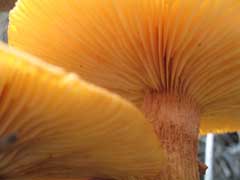
Armillaria luteobubalina
FUNGI
The first ever survey of Trigg Bushland was undertaken by the Perth Urban Bushland Fungi Project in 2006.
Download fungi list for Trigg Bushland (this takes you to the Perth Urban Bushland Fungi website where you can download the report).
Website development funded by a Department of Environment and Conservation Community Grant for Tuart Conservation and Management. Text and images copyright Friends of Trigg Bushland Inc except as otherwise noted. Website design by Nina McLaren and Peter Peacock 2008